Renovation · Older housing stock
In the mill blocks, renovation is a certainty, not an option.
Belmont's most charming housing was built fast, for mill workers, a century ago. Here is what it actually needs, in what order, and where the money comes back.
The short version
Buy the house for the street. Budget for the systems.
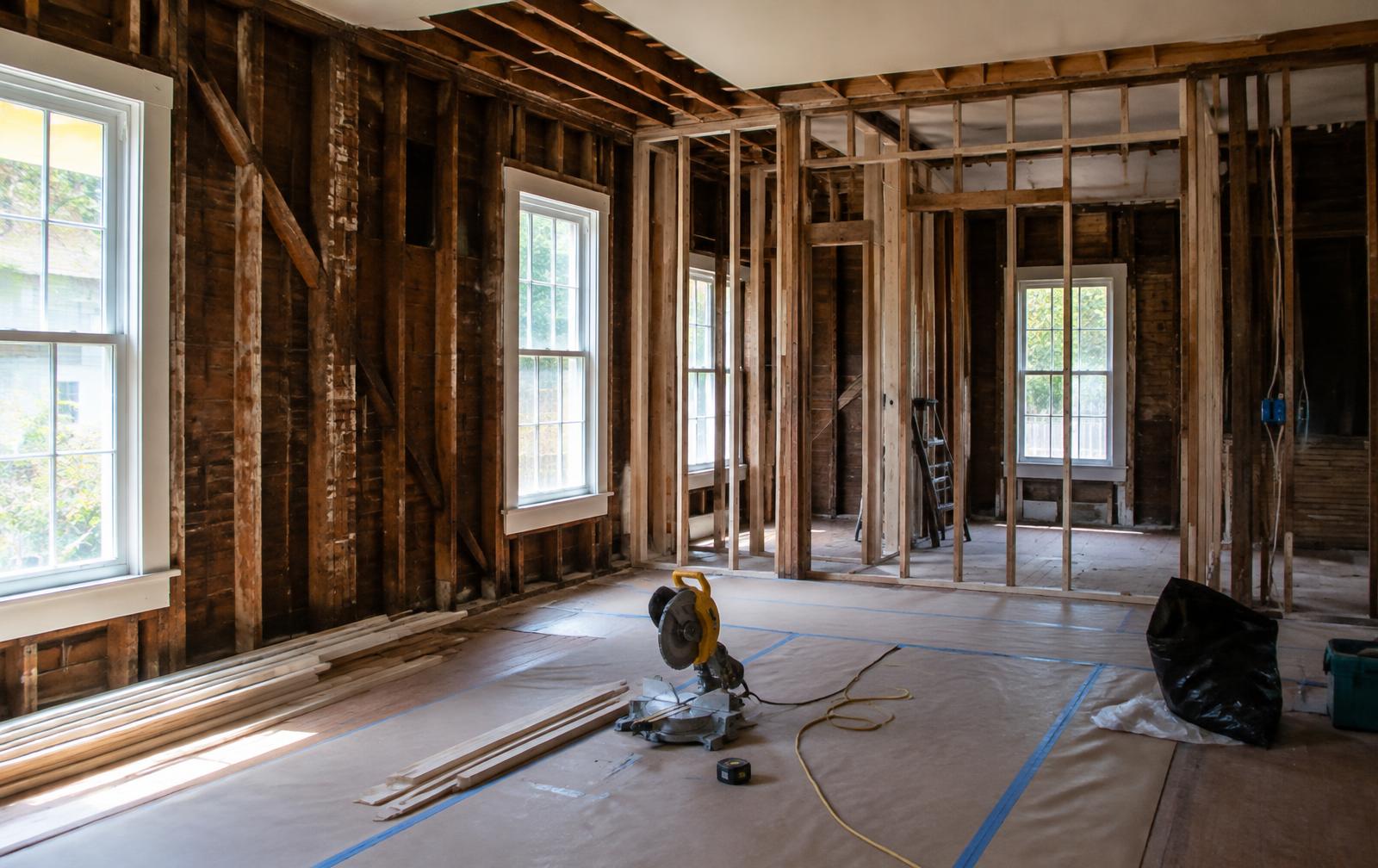
The walkable, characterful part of Belmont is largely pre-1940 housing: mill-village cottages and craftsman bungalows on small lots, most renovated at least once, often partially and often a while ago. What you are buying is location and proportion. What you are inheriting is wiring, plumbing, a crawlspace, a roof, and additions of uncertain provenance.
This is not a reason to avoid them — these houses are why Belmont is desirable, and a properly renovated cottage two blocks from Stowe Park is one of the better assets in Gaston County. It is a reason to sequence the work correctly and to price it before closing rather than after.
The order that matters: water first, then structure, then systems, then finishes. Every renovation that goes badly wrong in an old house went wrong by installing a beautiful kitchen above an unaddressed moisture problem.
01
What older Belmont houses typically need
Electrical
Common & non-negotiable
Knob-and-tube or early cloth-insulated wiring, ungrounded circuits, undersized panels, and decades of amateur additions. Full or partial rewiring plus a modern service is frequently required — and increasingly demanded by insurers.
Plumbing
Material-dependent
Galvanized supply lines corrode and restrict flow; cast-iron waste lines have finite life. Polybutylene, where present in later renovations, is its own problem. Scope both supply and waste, not just fixtures.
Crawlspace & moisture
The Piedmont issue
Vented crawlspaces in a humid climate produce standing moisture, fungal growth, and failing subfloors. Grading, gutters and downspout extensions, a vapor barrier, and often encapsulation with a dehumidifier — done in that order.
Foundation & piers
Inspect properly
Settlement, deteriorating brick piers, and shimmed girders are common. Get an engineer, not a salesperson, for anything structural.
Roof & flashing
Before interiors
Age, layers, valley and chimney flashing, and the condition of decking. Nothing inside should be finished under a roof with remaining life measured in single-digit years.
HVAC & ductwork
Whole system
Old equipment in unconditioned crawlspaces with leaking ducts wastes half its capacity. Replacement should include duct sealing or replacement and a proper load calculation, not a like-for-like swap.
Insulation & air sealing
Best return
Attic air sealing and insulation is usually the highest-value comfort improvement in these houses, and cheap relative to everything else.
Windows
Restore before replacing
Original wood windows are often repairable, and restoration with storms performs respectably while preserving the proportion that gives the house its character.
Hazardous materials
Pre-1978
Lead paint and asbestos in floor tile, mastic, siding, and pipe insulation are realistic in this stock. Test before disturbing anything and use certified handling.
02
Sequence and budget
A useful rule for Belmont's older houses: assume the unglamorous half of the budget is the half that determines whether the house is good. Systems, envelope, and water management first; kitchens and baths second; cosmetic last.
Phase 1 — water & envelope
Grading, gutters, downspouts, roof, flashing, crawlspace vapor barrier and dehumidification. Nothing else is durable until this is done.
Phase 2 — structure
Foundation, piers, girders, framing repairs, and any subfloor replacement resulting from moisture.
Phase 3 — systems
Electrical service and rewiring, plumbing supply and waste, HVAC with duct work, and low-voltage rough-in for network and audio while walls are open.
Phase 4 — envelope performance
Air sealing, insulation, window restoration or replacement, and exterior paint.
Phase 5 — kitchens, baths, finishes
The visible work, now sitting on top of a sound house. This is also where selections and lead times drive the schedule.
Phase 6 — exterior & landscape
Porches, hardscape, fencing, planting, and lighting.
Contingency
Fifteen to twenty percent for pre-1940 houses. Old buildings reveal themselves only once they are open, and the surprises are rarely pleasant.
03
Permits, unpermitted work, and insurance
Structural changes, electrical, plumbing, mechanical work, additions, decks, and most window and door opening changes require permits — through the City of Belmont inside city limits, or Gaston County outside them. Cosmetic work generally does not. When in doubt, ask before the work, not after.
Unpermitted prior work is extremely common in this housing stock: enclosed porches, finished attics, added bathrooms, and rewired circuits with no record. It affects appraisals, insurance claims, and resale disclosure, and it can require retroactive permitting or removal. Identify it during due diligence and price it, rather than inheriting it silently.
Insurers increasingly ask about wiring type, panel brand, roof age, and plumbing material on older houses, and some will decline or surcharge. Get a bindable quote during due diligence — not after closing — because an uninsurable house is a financing problem as well as a risk problem.
04
Where renovation money returns in Belmont
Returns well: documented systems
A new service and rewiring, new HVAC, and an encapsulated crawlspace with paperwork convert a buyer's risk discount into a premium. Keep every permit and invoice.
Returns well: kitchens and primary baths, done to neighborhood level
Quality matched to the street. Over-specifying past the neighborhood ceiling does not return in a market this small.
Returns well: usable outdoor space
A restored porch, a rear deck or patio, and proper landscape lighting read as square footage in this climate for a fraction of the cost.
Returns well: sympathetic additions
Adding a primary suite or a proper kitchen to a two-bedroom cottage addresses the stock's real limitation — if the massing stays subordinate to the original house.
Returns poorly: enclosing the front porch
It destroys the character the buyer is paying for. Screen it instead.
Returns poorly: over-improvement
The neighborhood ceiling is real. A luxury renovation on a modest street subsidizes the next owner.
Returns poorly: cheap window replacement
Losing original proportion and muntin pattern reduces the house's appeal permanently for a modest energy gain.
Returns poorly: finishes over unresolved moisture
The most expensive mistake available in Piedmont renovation, because the work gets done twice.
Renovation in Belmont
Old houses reward builders who have opened them before.
Knob-and-tube, brick piers, failing subfloor, and a rear addition that needs to disappear are ordinary in the mill blocks — and disastrous in inexperienced hands. The firm below handles custom work and renovations here.
Luxury custom home builder
Peters Custom Homes
Advertising disclosure. This is a paid or affiliated relationship: the firm above is affiliated with or compensates the publisher of this independent guide, and contacting it may result in a commercial engagement. It does not buy editorial placement. Full disclosure.
Questions & Answers
Belmont renovations — quick answers
Direct answers to what readers most often ask about this section of the guide. Each answer cites the primary source it rests on.
All Belmont questions →Are Belmont's older homes worth renovating?
+
Frequently, yes — the walkable in-town lots are the scarce asset, and a well-executed renovation on one of them competes with far newer houses elsewhere in the county. The work is only worth it when the structure, systems, and drainage are addressed alongside the finishes.
What should I expect renovating a mill-era house?
+
Knob-and-tube or early wiring, limited insulation, original single-pane windows, plumbing runs that predate modern fixtures, and floor framing that may need sistering. None of that is unusual; all of it belongs in the budget before cabinetry.
Source: ENERGY STAR residential guidance
Do I need a permit to renovate in Belmont?
+
Structural, electrical, plumbing, and mechanical work requires permits and inspections, and additions trigger zoning review. Confirm the scope with the city and the county inspections office before demolition.
Topic Cluster
Building & Design in Belmont
Construction, architecture, interiors, and integrated technology.
The Belmont Guide — Building & Design in Belmont →Our Sources
How this page was researched
Permitting thresholds and code requirements are set by the City of Belmont, Gaston County, and the North Carolina Residential Code, and change over time. Cost and return guidance is editorial judgment, not an appraisal or a bid.
Read our full citation methodology and editorial standards- 01City of Belmont — services, planning, and public records
City of Belmont, North Carolina
Municipal boundaries, utilities, planning, and downtown programs.
- 02Gaston County government services
Gaston County, North Carolina
County services, inspections, and administrative records.
- 03Licensed general contractor lookup
NC Licensing Board for General Contractors
Verification of builder licensing in North Carolina.
- 04Parcel, plat, and property record lookup
Gaston County GIS
Lot sizes, parcel boundaries, ownership, and sale history.
- 05Local history collections and archives
Gaston County Public Library
Historical record of Belmont, its mills, and the Abbey.
Figures such as pricing, assessments, and school assignment change over time. Always confirm current details directly with the source before making a decision.
Custom Homes in Belmont
Lot evaluation, permitting, and estate-grade building on this side of the river.
Continue →Belmont Architecture
Mill houses, Craftsman cottages, Abbey stone, and modern waterfront.
Continue →Interior Design in Belmont
Palettes and interior architecture for river-light houses.
Continue →Smart Home & AV in Belmont
Networking, cinema, lighting, and dockside audio done at framing.
Continue →