Belmont Abbey · Since 1876
The monastery that named the town.
Benedictine monks arrived on Gaston County farmland in 1876. Ten years later they asked for the post office to be renamed Belmont — and it was.
The short version
A working abbey, a Division II college, and a minor basilica.
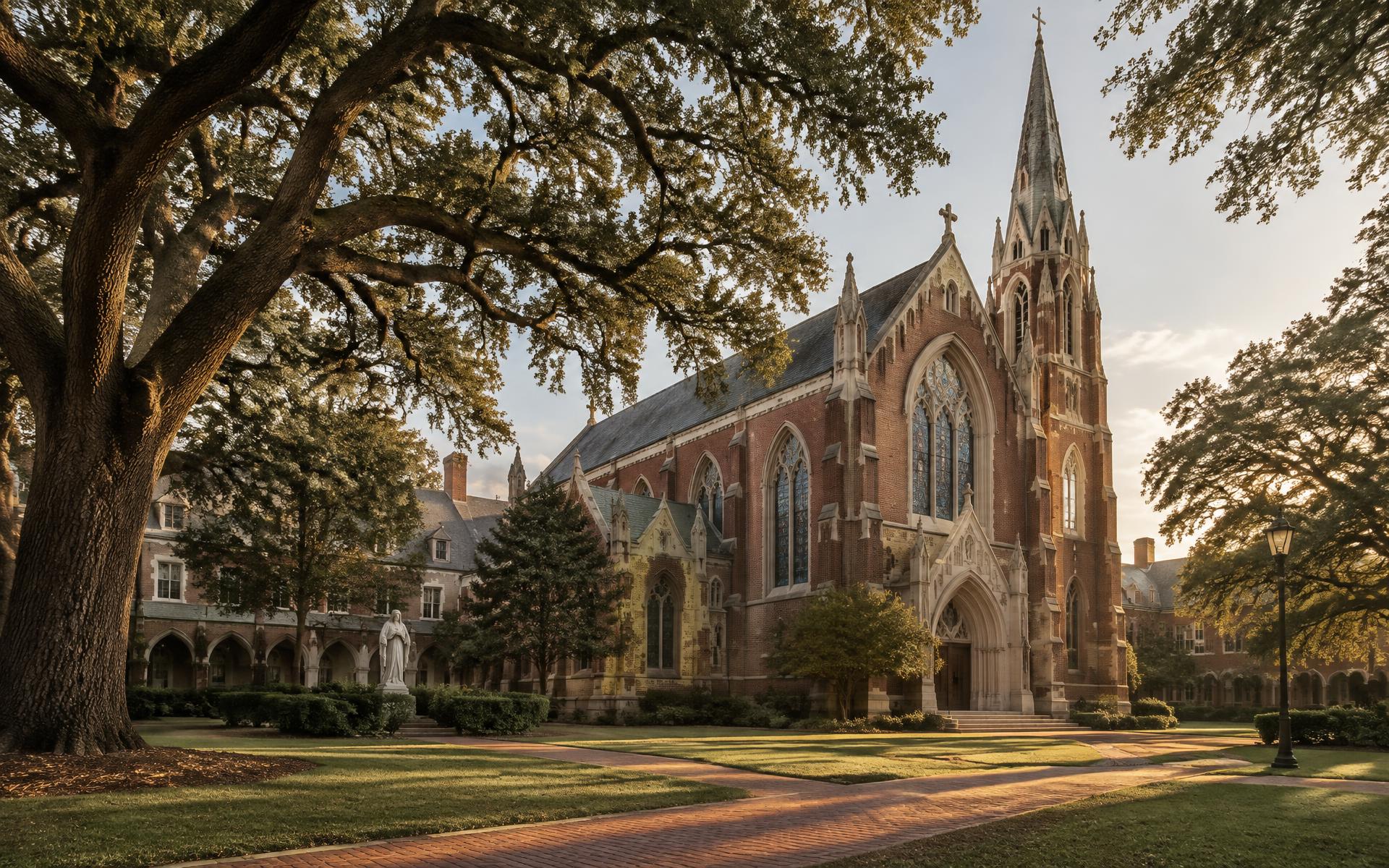
Belmont Abbey sits just north of downtown on a wooded campus off Belmont–Mt. Holly Road, a mile from Main Street and directly accessible from I-85. It is three things at once: a Benedictine monastic community founded in 1876, a four-year Catholic liberal arts college chartered in 1886, and the Basilica of Mary Help of Christians — completed in 1892 and elevated to minor basilica status by the Vatican in 1998.
The abbey is also the reason the town has its name. The Benedictines requested the change from Garibaldi Station to Belmont in 1886 — bellus mons, beautiful mountain — which is why a Piedmont river town with no mountain anywhere near it carries that name.
For residents, the campus functions as a neighbor rather than a landmark: a place to walk, to attend a concert or a lecture, to watch NCAA Division II Crusaders athletics, and — for many families — to send a student without leaving the county.
01
What is actually on the campus
The Basilica
1892 · Basilica since 1998
Gothic Revival in red brick, with stained glass produced in Munich and a bell tower visible from the interstate. An active parish church as well as a monastic one — open to visitors, with Mass and office times posted by the abbey.
The monastery
Founded 1876
The Benedictine community that owns and maintains the campus, following the Rule of St. Benedict. Not a museum; monks live and pray here daily.
Belmont Abbey College
Chartered 1886
A small Catholic liberal arts college — roughly 1,500 students, a classical core curriculum, and one of the more affordable private tuitions in the Carolinas.
Crusaders athletics
NCAA Division II
Conference Carolinas competition across roughly two dozen sports, with games that function as community events for Belmont families.
The grounds
Open to the public
Mature hardwoods, brick walks, a cemetery, and the abbey's own history markers — a genuinely pleasant walk, and a favorite spot for Belmont photographers.
02
Visiting respectfully
The basilica welcomes visitors and the grounds are open, but this is a monastic community and an operating campus, not an attraction. Check the abbey's posted schedule before arriving, avoid wandering into the monastery's private areas, keep quiet inside the church, and be mindful during liturgies, weddings, and funerals.
Weekday mornings and mid-afternoons are the calmest. Parking is on campus and free. If you want context before you go, the abbey's own history pages are the primary source — and considerably more reliable than third-party travel write-ups.
03
What the Abbey means for the neighborhoods around it
The campus acts as a permanent green buffer on Belmont's northern side. Where a comparable tract elsewhere in the Charlotte ring would have been subdivided decades ago, this one is institutionally owned and unlikely to change — which stabilizes the character of the streets that back up to it.
It also brings a student and faculty population, which supports downtown businesses through the academic year, and an event calendar — concerts, lectures, athletics, commencement — that residents can walk or drive to in five minutes.
Houses near the campus tend to be older in-town stock, in the North Belmont and central blocks. If proximity matters to you, verify school assignment separately; a college address tells you nothing about which Gaston County elementary serves the street.
Visiting
Planning a respectful visit
Worship
The Basilica is an active church. Check the Abbey's current Mass and prayer schedule before visiting and keep tours outside service times.
Campus
The college is a working campus. Park in visitor areas and follow posted signs during the academic year.
Events
Lectures, concerts and athletics are often open to the public; confirm details with the college.
For residents
Living near the Abbey
The Abbey and college shape the east side of town: a green, historic campus, events that bring visitors, and game-day and move-in traffic at predictable times of year. Buyers looking nearby should drive the area during a busy weekend and check whether a home is inside city limits.
Questions & Answers
Belmont Abbey — quick answers
Direct answers to what readers most often ask about this section of the guide. Each answer cites the primary source it rests on.
All Belmont questions →What is Belmont Abbey College?
+
A private Benedictine liberal arts college on Belmont–Mt. Holly Road. Benedictine monks founded the monastery in 1876 on land donated four years earlier; it was chartered as St. Mary's College in 1886 and renamed Belmont Abbey College in 1913. It became a four-year institution in 1952 and competes in NCAA Division II as the Crusaders.
Source: Belmont Abbey College
Can you visit the Basilica of Mary Help of Christians?
+
The church, built in 1892, was listed on the National Register of Historic Places in the early 1970s and designated a minor basilica by Pope John Paul II on July 27, 1998. Check current visiting and Mass times directly with the abbey before planning a visit.
Source: Gaston County GIS / parcel and property lookup
Is the monastery still active?
+
Yes. The Benedictine community remains on campus, and the abbey has been an independent abbey since December 19, 1884, when Leo Haid was soon after elected its first abbot.
Source: Belmont Abbey College
Topic Cluster
Belmont Landmarks & Waterfront
Downtown, the Abbey, the Conservancy, the river, and the trails.
The Belmont Guide — Belmont Landmarks & Waterfront →Our Sources
How this page was researched
Institutional history, Mass schedules, and enrollment figures come from Belmont Abbey and Belmont Abbey College directly. This guide is independent and not affiliated with the abbey, the college, or the Diocese of Charlotte.
Read our full citation methodology and editorial standards- 01
Belmont Abbey College — history and campus
Belmont Abbey College
Founding history, the Basilica, and campus information.
- 02
Local history collections and archives
Gaston County Public Library
Historical record of Belmont, its mills, and the Abbey.
- 03
City of Belmont — services, planning, and public records
City of Belmont, North Carolina
Municipal boundaries, utilities, planning, and downtown programs.
- 04
Visitor guides for Belmont and Gaston County
Gaston County Tourism
Dining, events, attractions, and things to do.
Figures such as pricing, assessments, and school assignment change over time. Always confirm current details with the named organization, or ask the Peters team, before making a decision.
History of Belmont
Garibaldi Station, the Abbey, the cotton mills, and the downtown revival.
Continue →Belmont Schools
Gaston County assignments, private options, and South Point High.
Continue →Things to Do in Belmont NC
A weekend's worth of river, garden, Main Street, and nearby Charlotte.
Continue →Downtown Belmont & Main Street
The walkable core: Stowe Park, the shops, and the restaurant row.
Continue →